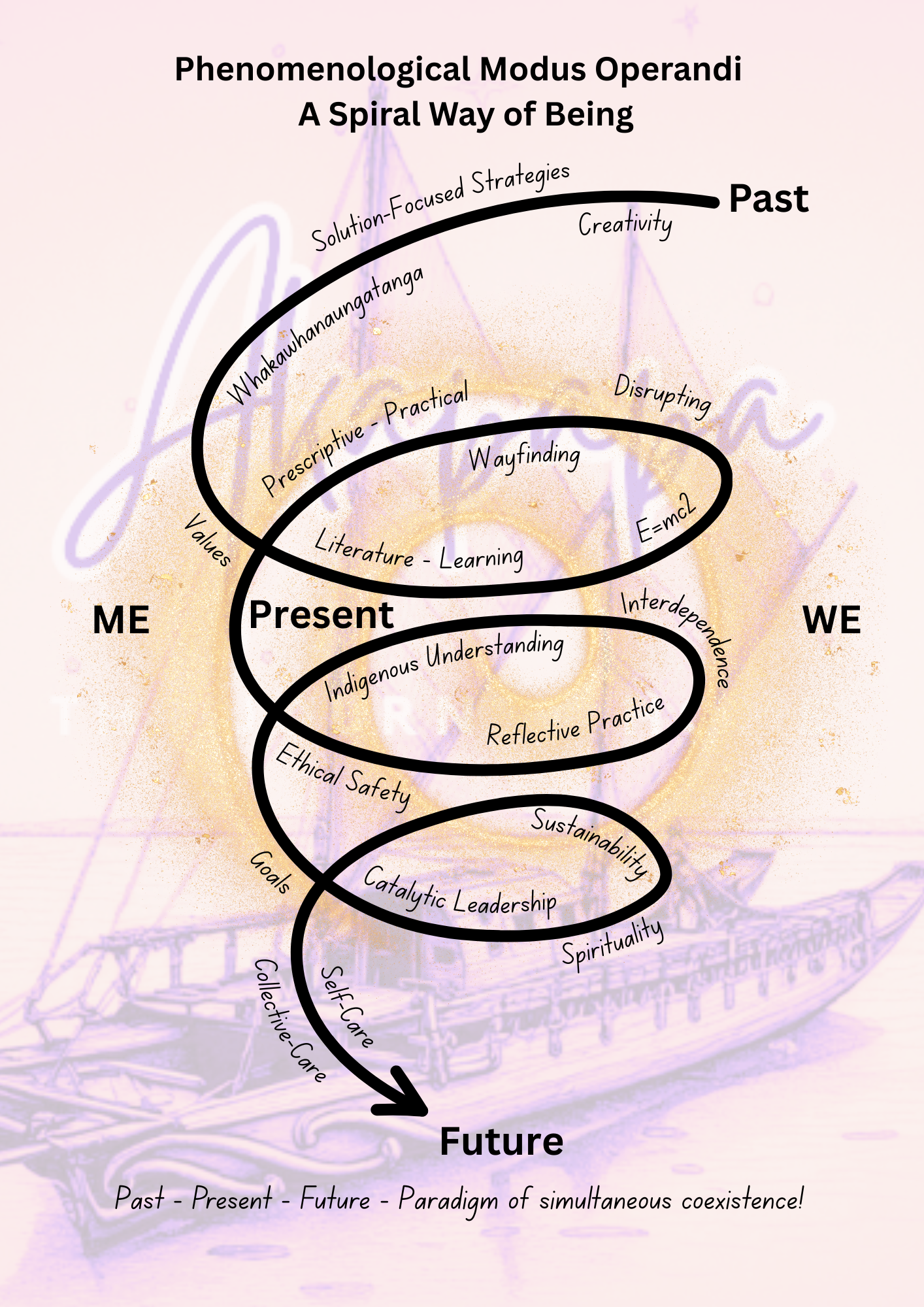
“First it’s awareness, then a pause, then a different choice, then a daily practice, then a natural response… then it’s just how you relate.” – Ingrid Campbell
There are seasons in life when the road disappears beneath us, when we are called to walk not with certainty, but with courage. This post is about that kind of journey. The one that doesn’t come with a map, but asks us to wayfind from within.
Over the last two years, through my Master of Professional Practice, I’ve been exploring what it means to live and work sustainably in the aftermath of trauma, burnout, and spiritual abuse. This has been more than academic, it’s been a lived journey of unravelling, remembering, and reweaving who I am, how I work, and what sustains me.
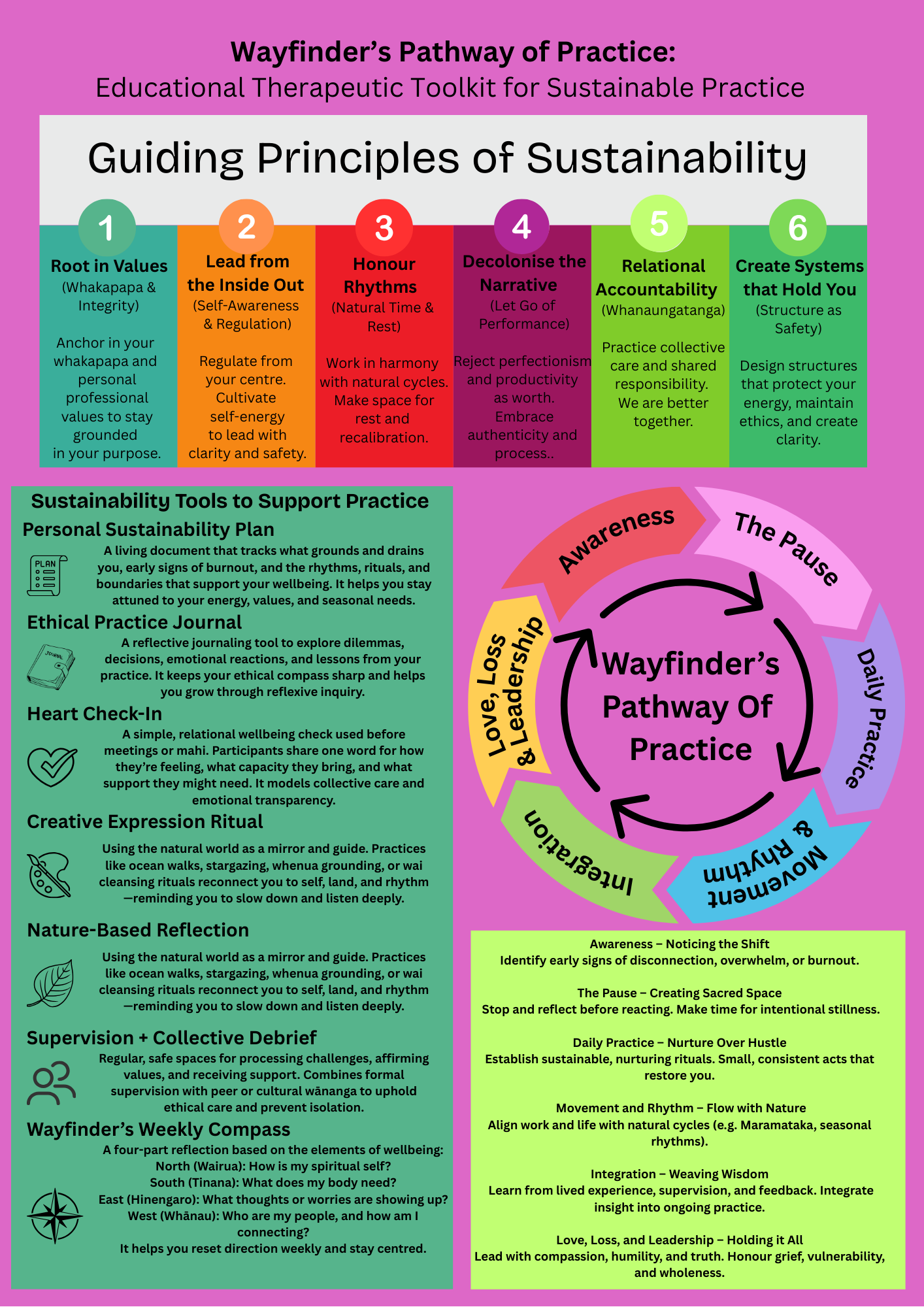
From that journey came a framework I call The Wayfinder’s Pathway of Practice, six guiding principles that support both personal healing and professional sustainability.
🧭 The Wayfinder’s Pathway
1. Awareness
This is where it begins, noticing without judgment. Trauma taught me to be hyperaware of others, but not of myself. Reclaiming awareness meant tuning into my body, breath, and inner voice. It’s a sacred kind of noticing.
2. The Pause
In cultic systems, I was trained to respond out of fear or urgency. Learning to pause, to interrupt automatic reactions, became an act of resistance. The pause allows me to ask: Is this aligned with who I really am?
3. Daily Practice
Sustainability isn’t a one-off choice. It’s built through rhythm. For me, that means journaling, checking in with my parts, walking barefoot, and reconnecting with whenua. Tiny rituals restore wholeness when the world feels fragmented.
4. Movement and Rhythm
This stage is about honouring life’s flow, allowing grief to move through, not be trapped. It includes somatic work, creativity, dance, rest, and action. As Māori and Pacific frameworks remind us: we are relational, rhythmic, and constantly evolving.
5. Integration
Not just surviving, but weaving the pieces together. Integration honours complexity. For me, this means acknowledging my parts (as someone living with DID), letting them coexist, and finding unity through compassion.
6. Love, Loss, and Leadership
Leadership, to me, is deeply relational. It begins with self-leadership: how I respond to grief, how I hold space, how I model integrity. It is also love in action, rooted in values, not ego. I’m learning to lead from my humanity, not from performance.
🌿 Cultural and Theoretical Roots
This pathway is grounded in Indigenous frameworks like Te Whare Tapa Whā (Durie, 1998), Fonofale (Pulotu-Endemann, 2001), Wayfinding Leadership (Spiller et al., 2015), and Gillie Jenkinson’s (2022) trauma recovery model for survivors of coercive control. It weaves poetic inquiry, somatic wisdom, and reflexive practice into a living, breathing guide for navigating the unknown.
As Bishop (2020) reminds us, sustainable practice is not about separating the personal and professional, it's about working with integrity across all domains of life. For me, this is what sustainability looks like: a series of intentional, compassionate choices that keep me tethered to truth.
Copyright Ingrid Campbell
💛 Why This Matters
I’m not interested in becoming a therapist who burns bright and burns out. I want to build a life and practice that holds, that breathes, that remains in relationship with the whenua, with my culture, and with my own healing.
This pathway is for anyone who’s ever lost their way… and is learning how to come home.
It all begins with an idea. Maybe you want to launch a business. Maybe you want to turn a hobby into something more. Or maybe you have a creative project to share with the world. Whatever it is, the way you tell your story online can make all the difference.
Don’t worry about sounding professional. Sound like you. There are over 1.5 billion websites out there, but your story is what’s going to separate this one from the rest. If you read the words back and don’t hear your own voice in your head, that’s a good sign you still have more work to do.
Be clear, be confident and don’t overthink it. The beauty of your story is that it’s going to continue to evolve and your site can evolve with it. Your goal should be to make it feel right for right now. Later will take care of itself. It always does.
References:
Berryman, M., SooHoo, S., & Nevin, A. (2013). Culturally responsive methodologies.
Bishop, R. (2020). Indigenous research methods.
Durie, M. (1998). Whaiora: Māori health development.
Jenkinson, G. (2022). Recovery from Cults and Coercion.
Pulotu-Endemann, F. K. (2001). Fonofale Model of Pacific Health.
Schwartz, R. (2021). No Bad Parts.
Spiller, C., Barclay-Kerr, H., & Panoho, J. (2015). Wayfinding Leadership.
